
Sharing a Fence in Melbourne: The Fencing Notice Comes Before the Fencer Starts
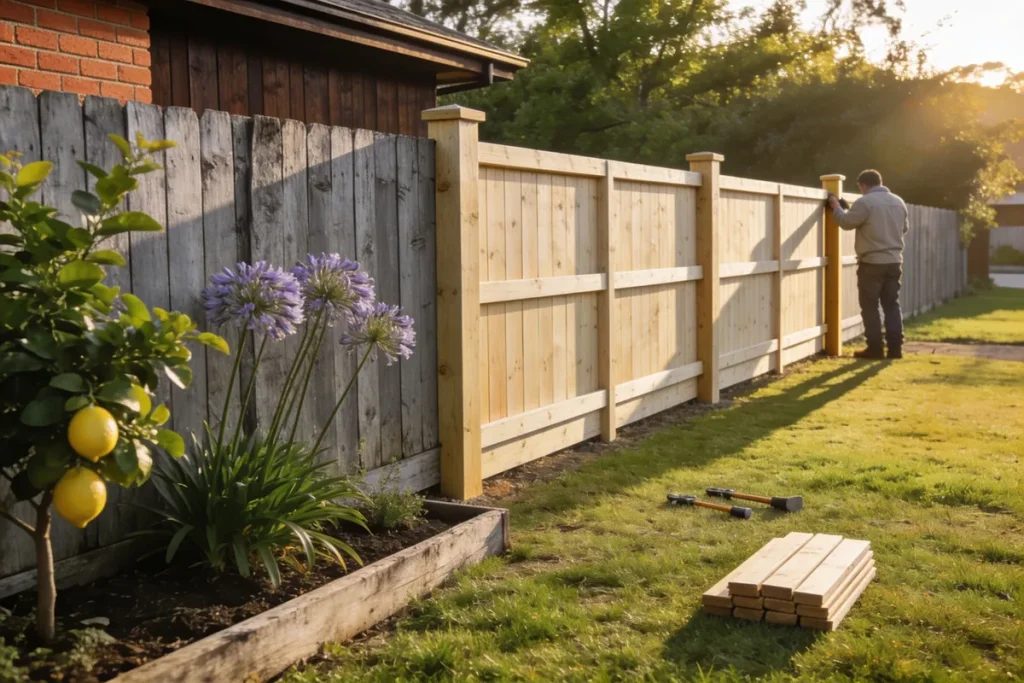
The usual sequence on a Melbourne boundary runs backwards. One owner tires of a leaning paling fence, books a fencer, and then walks next door to mention that work starts on Monday and the bill will be shared. The Fences Act 1968 (Vic) expects a different order. Section 12 says fencing works are to be carried out under a fencing notice agreement, an order of the Magistrates’ Court, some other agreement between the owners, or the process the Act itself sets out. A conversation over the side gate after the posts have gone in fits none of those.
The order the Act supports is short: obtain a written quote, put it inside a fencing notice, serve the notice, wait 30 days, then build. This article works through each step with the relevant section attached, so any statement here can be checked against the Act. It is general information about the Act, not legal advice.
The calculator below does the arithmetic of sections 7 and 8, and its result is the split that goes into the notice.
Fence cost share estimator
Enter your fencer's written quote to see how the cost splits between you and your neighbour under sections 7 and 8 of the Fences Act 1968 (Vic).
Enter the total quote, the price of a standard fence if your quote is for something more, and who wants the upgrade. The split follows sections 7 and 8 of the Fences Act 1968 (Vic).
Enter the total quote to see the split.
Standard fence cost: the price of a sufficient dividing fence, the figure both owners share (s 6, s 7).
Each owner pays an equal share of a sufficient fence unless you agree otherwise (s 7, s 7(3)).
The cost above a standard fence is paid by the owner who wants it (s 8).
Percentages are each share of the total quote, as item 10 of the fencing notice asks.
An estimate based on the Fences Act 1968 (Vic) sections 7 and 8. Neighbours can agree to split costs differently. If you can't agree, the Dispute Settlement Centre of Victoria offers mediation and the Magistrates' Court can decide.
Who pays, and for what
The starting rule is in s 7. Owners of adjoining land contribute in equal proportions to a sufficient dividing fence. Section 7(3) allows the owners to agree on other proportions, so the equal split is a default rather than a fixed requirement. Two neighbours who settle on a different arrangement, and record it, are acting within the Act.
Everything hangs on the word “sufficient”. Section 6 lists the matters that decide what a sufficient dividing fence is on a given boundary:
- the existing dividing fence, if there is one
- the use of the land on each side
- privacy
- the types of dividing fence usual in the locality
- any council policy on fences
- the planning and building rules that apply
The Act does not name a single height or material. The Victorian Government’s Fencing in Victoria page says that for residential land, a sufficient fence is typically a 1.8 metre timber paling fence. That line is government guidance, not a provision of the Act, and the s 6 factors can point elsewhere on a boundary where the land use, or the fences usual in the street, differ.
Section 8 deals with upgrades. An owner who wants a fence above the sufficient standard, whether higher or built from dearer materials, pays the difference. Section 9 deals with damage: where a dividing fence is damaged by an owner’s negligent or deliberate act, that owner bears the cost.
| Situation | Who pays | Section |
|---|---|---|
| A sufficient dividing fence, nothing extra | Both owners, in equal proportions | s 7 |
| The owners agree on a different split | As agreed | s 7(3) |
| One owner wants a higher fence or dearer materials | That owner pays the difference above a sufficient fence | s 8 |
| The fence is damaged by one owner’s negligent or deliberate act | That owner | s 9 |
Read in order, the provisions work as a sequence: decide what a sufficient fence is for this boundary, price it, split that price equally unless both owners agree otherwise, and put anything above it on the owner who asked for it. The calculator runs the same steps.
Quote first, because it goes in the notice
A fencing notice cannot be completed without a cost figure. Section 13(3)(h) requires the notice to state an estimate of the cost of the works, the basis of that estimate, the proportions each owner is to pay, and the amount the other owner is being asked to contribute. The Victorian Government’s standard notice template collects all of this at item 10, where the basis is ordinarily a quotation from a fencing contractor. The quote comes first, and its quality sets the quality of the notice.
A quote that can carry a fencing notice states, at minimum:
- the length of fence to be built or replaced
- the height
- the type of fence and its material
- demolition and removal of the old fence
- a separate price for a standard fence, where either owner wants an upgrade
The last item is the one most often missing. Without a standard price on paper, s 8 cannot be applied with any precision, because there is nothing to measure the upgrade against, and both owners are left to argue about what the standard version would have cost. A second line on the quote prevents that argument.
The quote should also say which side the rails and framing will face. Section 32 deals with rails and framing, and settling the point at the quote stage means it can be described in the notice instead of discovered on installation day.
Writing and serving the notice
Section 13(3) sets the contents of a fencing notice. The table below maps each requirement to what it looks like on paper.
| What the notice must state | In practice |
|---|---|
| The date | The date the notice is given |
| Your details | Name and address of the owner giving the notice |
| That it is a notice under s 13 | The government template’s heading names it a fencing notice under section 13 |
| The boundary line | Which boundary the works are on |
| The works and the type of fence | What is to be built or replaced, and the fence proposed |
| Who may carry out the work, s 13(3)(g) | Usually the fencer named on the quote |
| The estimate, its basis and each owner’s share, s 13(3)(h) | The quote, plus the dollar amount the neighbour is asked to pay |
| That either owner may go to the Dispute Settlement Centre of Victoria, s 13(3)(i) | A fixed statement, already printed in the template |
The Victorian Government publishes the standard template, and using it is the simplest way to cover every item. It also includes a response form for the neighbour, which gives any reply a defined shape.
Section 37 allows a notice to be given personally or sent by post. The Victorian Government page suggests registered post, which leaves a record that the notice was sent. Keep the notice, the attached quote and the postal receipt together, because each later step relies on showing that the notice was given and when.
Sometimes the neighbouring owner is not the person living next door. Section 14 requires reasonable inquiries to find the owner. Under s 14(2), a council may disclose an owner’s name and address for this purpose. A LANDATA title search is the other route, and it attracts a fee.
The 30 days
Once the notice is served, the neighbour has 30 days. What follows depends on which of three responses arrives.
| Neighbour’s response | What follows | Section |
|---|---|---|
| Agrees | The works proceed on that agreement | s 12 |
| Responds but disagrees | After the 30 days, either owner may take the matter to the Magistrates’ Court | s 17 |
| No response within 30 days | The works may commence, and the neighbour’s share is recovered afterwards | s 19, s 21 |
The no-response row answers the question readers search for most often, usually phrased as some version of “my neighbour won’t pay for half of the fence”. The Act’s answer is procedural. Where a notice has been properly served and 30 days pass without a response, s 19 allows the works to commence, and s 21 provides for recovering the neighbour’s contribution afterwards. The Victorian Government describes that recovery as running through the Magistrates’ Court. Each of those steps depends on the notice being complete and its service being provable, which is why the two previous sections deserve the time.
Disagreement takes a different path. A neighbour who replies and objects to the cost, the fence type or the split has responded, so the matter moves to s 17, and after the 30 days either owner may go to the Magistrates’ Court. Before that point, the Dispute Settlement Centre of Victoria offers mediation. The Victorian Government also recommends that neighbours talk before any notice is sent. Done in that order, the notice records a conversation that has already taken place, rather than opening one by post.
When it can’t wait
Some fencing problems cannot sit through a 30-day notice period. Section 23 deals with urgent fencing works. Where such works are carried out, s 24 provides for an urgent fencing notice, which sets out the work done, its cost and why it was urgent.
For an owner in this position, the practical concern is evidence. The urgent notice has to explain why the work could not wait, so photographs of the fence and the fencer’s invoice are what it will be built from. The urgency provisions are a narrow exception, and a notice is still required.
Choosing a fencer for a shared job
A shared boundary asks more of a fencer than a private job does, because two owners and a statutory process sit behind the work. Four qualities distinguish a fencer suited to it.
- A written quote that prices the standard fence and the upgrade separately. This is the s 8 line from earlier, and a fencer unwilling to split the price makes the notice harder to write.
- Willingness to be named on the notice. Section 13(3)(g) asks who may carry out the work, and a fencer comfortable being named there is comfortable with the neighbour knowing who quoted and for how much.
- Patience with the 30 days. The start date has to fall after the notice period, or after an agreement is reached. A fencer pressing for an earlier start on a shared fence is pressing against s 12.
- Working to the agreed line. The notice describes a boundary, and the fence belongs where the notice says.
Where the boundary itself is in doubt, settling it falls outside a fencer’s job. Division 3 of the Act provides for a boundary survey notice (s 28), and locating a boundary is work for a licensed surveyor. Fixing the line first keeps the fencing notice accurate.
Two related situations on Melbourne boundaries call for other specialists. A front fence on a property covered by a heritage overlay brings planning considerations into the decision, and our guide to renovating a heritage home in Melbourne covers how overlays shape that kind of work. Stormwater pipes or drains running along the boundary line are licensed plumbing work, so protecting or moving them while a fence goes in is a plumber’s job, and the guide on how to choose a plumber in Melbourne sets out what to check before booking one.
Thirty days, then the post-hole digger
Reduced to its working parts, the sequence has four steps, each tied to a section of the Act.
| Step | What it involves | Section |
|---|---|---|
| 1. Quote | Written, with a standard fence priced separately if anyone wants an upgrade | s 8, s 13(3)(h) |
| 2. Notice | The government template, completed and served personally or by post | s 13, s 37 |
| 3. Wait | 30 days, ending in agreement, disagreement or silence | s 17, s 19 |
| 4. Build | Under an agreement, a court order or the Act’s own process | s 12 |
An owner who books the fencer first has swapped steps one and four and skipped the two in between. An owner who follows the table reaches the build with a quote both sides have seen, a notice that meets s 13, and a record of how the neighbour responded, if at all. The calculator at the top produces the item 10 figures for the notice.
Sources: Fences Act 1968 (Vic), Authorised Version No. 072 (https://www.legislation.vic.gov.au/in-force/acts/fences-act-1968/072); Victorian Government, Fencing in Victoria (https://www.vic.gov.au/fencing-victoria); Victorian Government, Standard fencing notice, section 13 template (https://www.vic.gov.au/sites/default/files/2026-01/Standard-fencing-notice.pdf)