
How to Choose a Plumber in Melbourne: The Licence, the Quote and the Certificate

Why ten minutes of checking is worth more than any review
If this is your first time hiring a plumber, you are in good company. Most people meet a plumber the way they meet a dentist: something has gone wrong, and the search starts that same morning. So it helps to know at the outset that plumbing is one of the trades you cannot really assess by eye. A neat job and a poor job can look identical on the afternoon the van pulls away.
What you can assess is smaller, and more useful. You can find out who is actually doing the work, what they have promised you in writing, and what they hand you at the end. Those three things are what this article is about, and taken together they ask less of your time than choosing where to eat on a Friday night.
None of it asks you to be suspicious of anyone. It only asks you to know which few things are worth checking, and then to check them. Once you know which ones matter, they take minutes.
Check the licence, not the logo
In Victoria, the licence belongs to the person, not the business
Before you ring anyone, there is one thing worth knowing. In Victoria, plumbing licensing sits with individual practitioners, and the public register is a register of practitioners, not of businesses. So ringing a company and being told “yes, we’re licensed” is a friendly answer, but it is not a check, because there is nothing in it you can look up.
What you can look up is a person. Ask for the name of the individual plumber who will do the work, as it appears on their licence, together with their licence number. Then look that person up. Victoria’s plumbing regulator is the Building and Plumbing Commission, and its public tool for exactly this is called Find and check a practitioner, at bpc.vic.gov.au.
It is also worth noticing when the names do not line up. If the trading name on the van, the name on the invoice and the name on the licence are three different things, that is a moment to pause and ask, rather than to shrug.
What “licensed” actually covers
A licence is not one single thing. Victorian plumbing classes cover water supply, sanitary plumbing, gasfitting, roofing and stormwater, mechanical services and fire protection, and specialised classes such as backflow prevention, thermostatic mixing valves and Type A and Type B gasfitting are held separately again.
The practical version of that is simple. A plumber who is licensed for your leaking tap is not automatically licensed for the gas work beside it. So when you ask for a licence number, ask which class of work covers your job. A clear answer tells you the person is across their own scope, which is exactly what you want to know before anyone touches a gas line.
The check anyone can do in under a minute
The whole check fits into about a minute. Get the individual’s full name as it appears on their licence. Get the licence number. Search the regulator’s public register, and read what comes back: the name, the class of work, and whether the licence is current. A number that will not be given, or a search that returns a different name, ends the conversation before a quote is even discussed.
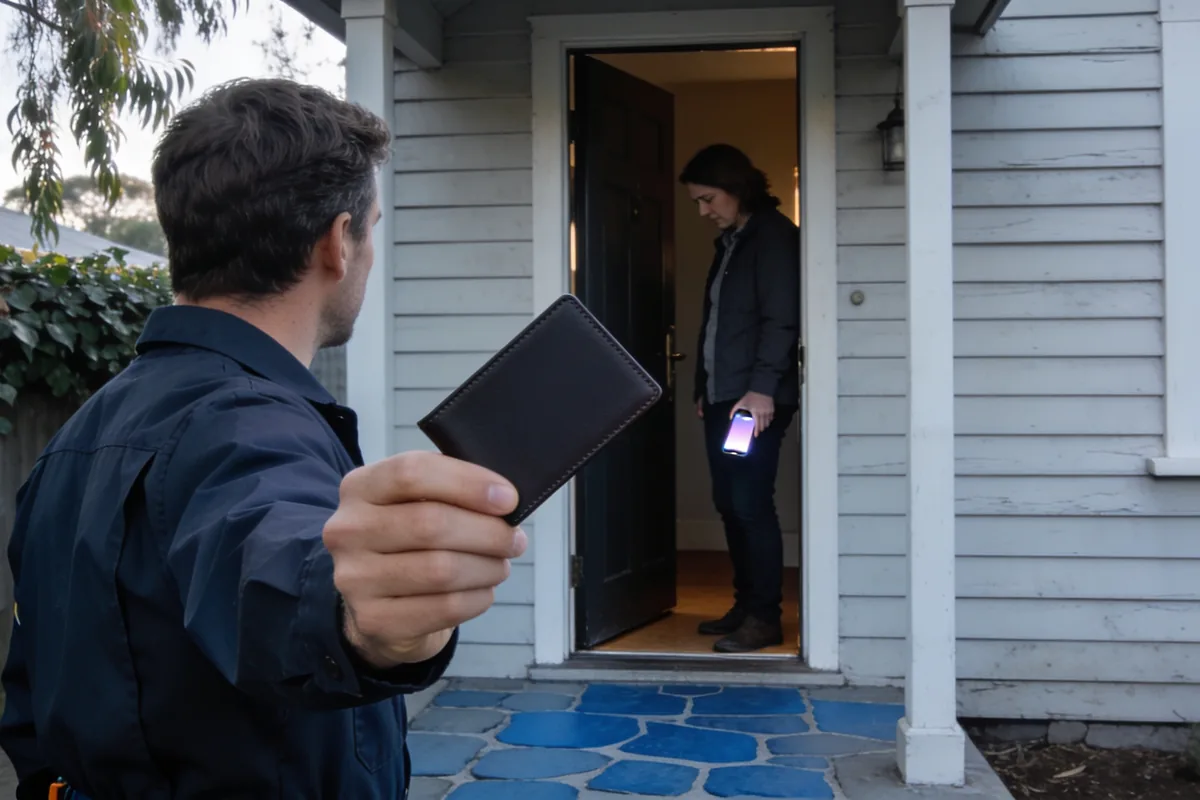
And a word of reassurance, because this can feel awkward the first time. Checking a plumber’s licence is ordinary practice. The register exists for precisely this, and no legitimate plumber minds being asked.
Insurance: ask for the certificate, not the reassurance
Licensed plumbers in Victoria must hold public liability insurance with a minimum cover of $5,000,000. That figure is prescribed under the Building Act 1993 and the Licensed Plumbers General Insurance Order, and it is set for your protection as much as the plumber’s. You do not need to memorise the figure; you only need to know that the cover is required, and that you are allowed to ask to see it.
For a homeowner, that rule comes down to a small ask. Before work starts, ask for a certificate of currency. It is a short document from the insurer, and it is worth reading rather than glancing at. Look for the plumber’s own legal name, not only a company name, along with the insurer, the policy number and the period the cover runs for. A certificate that names only a business, when the person turning up is someone else, deserves a follow-up question.
This is not about doubting anyone. Insurance is the thing standing between a damaged floor or a burst pipe and an argument about who pays. A plumber who carries proper cover is usually quick and relaxed about showing it, because it costs them nothing to do so. A refusal, or a dodge, is information in itself.
What a fair quote looks like
Call-out fee, hourly rate or fixed price
Before anyone arrives, it helps to know which of three things you are being sold. One is a call-out fee, sometimes with an hourly rate on top. Another is a straight hourly rate. The third is a fixed price for the whole job.
Get the answer in writing. If it is a call-out fee plus an hourly rate, ask what the fee includes, and whether after-hours, weekend and public holiday rates are different, because emergency work is where the pricing gets sharpest. If it is a fixed price, ask what is included and what could change it. None of those questions is unusual, and the plumber who answers them clearly is showing you how the rest of the job will go. It is fair to ask for the whole picture in one document, so nothing arrives as a surprise on the day.
A written quote describes a job, not just a number
A quote becomes useful when it describes a job. A single figure with nothing under it cannot be compared with anything, including the quote you get next.
So look for a quote that says what is going to be done, which parts are included and who is supplying them, whether the price is fixed or an estimate, and whether GST is already in the figure. Ask what happens if the job turns out bigger than the first look suggested, because that is where most disagreements begin. A plumber who puts a scope in writing is not being fussy for the sake of it. They are giving you something you can hold them to, and something you can compare fairly against the next quote.
Why the cheapest quote is rarely the cheapest job
If a quote comes in well below the others, treat it as a question rather than a bargain. Ask what it leaves out. The usual answers are cheaper materials, a compliance certificate that quietly never gets issued, or a scope that deals with the visible problem but not the cause of it. A lower number is only cheaper if it is buying the same job.
The certificate most homeowners never ask for
This is the part of the process that is genuinely Victorian, and it is the part most people only learn about afterwards.
In Victoria, a compliance certificate is required for plumbing work valued at $750 or more. It is also required for certain prescribed work regardless of value, including installing, relocating, replacing or converting a gas-using appliance, work on consumer gas piping, below-ground sanitary drains and gullies, and cooling towers. A licensed plumber issues it, and it is not something you apply for yourself. A registered plumber cannot issue one for work above the threshold, which is one more reason the licence check in the section above matters.
The certificate matters because it is the document that makes the work both legal and insurable. Without it, the work can be treated as non-compliant, and an insurer may question it later if you ever need to claim. It is also the record a future buyer may ask to see when you sell the house.
Your own job here is a small one. Raise it plainly, at the quote stage, by asking who will issue the compliance certificate for this work and when you will receive it. Then check that it arrives within a short set period after the work is finished, and keep it with the house papers alongside your other documents. For gas work in particular, treat it as non-negotiable rather than optional.
There is a simple way to remember the ask. Put the certificate question in the same breath as the price: what will this cost, and who will issue the compliance certificate?
None of this is meant as a lecture about rules. It is simply what you are owed, and how to ask for it without feeling like you are making a fuss.
Red flags that appear before any work starts
Most of what goes wrong goes wrong before a spanner is picked up, and the signs usually show in the conversation rather than in the work. None of the following is proof of a bad operator on its own. Each one is simply a reason to slow down and ask the next question.
- A verbal number with no written quote behind it.
- Pressure to decide on the spot, or a diagnosis that sounds urgent and that only this operator can fix today.
- A large deposit, or full payment, demanded before the job has even been assessed.
- No licence number, or a number that will not be given when you ask.
- A request for cash so the paperwork can be skipped.
- A business name on the quote that does not match the person doing the work, or the name on the insurance.
- Different trading names across the van, the quote and the invoice.
Two quieter signs are worth adding to that list. A written scope that changes shape each time you ask about it is one. An explanation that shifts whenever you press for detail is another. Both suggest the person is not quite across the job they are quoting.
If one of those appears, you have not necessarily found a rogue. You have found a cue to pause, ask the question again, and watch how the answer comes back. In practice, the way someone responds to a calm question tells you more than the answer itself.
Before you book: the checks in one place
Everything above fits into one short list, and it is worth keeping beside you when you make the calls. Run through it once before you book, and once more when the job is done. It reads quickly, and it is meant to be used rather than admired.
Before you book: the plumber checklist
- The individual plumber’s full name and licence number written on the quote
- That name checked on the regulator’s public register, with the class of work matching your job
- A certificate of currency for public liability insurance, naming the plumber (not just a company)
- Call-out fee, hourly rate or fixed price stated in writing, including after-hours rates
- A written quote that says what is done, what parts are included and whether GST is in the figure
- Confirmation of who will issue the compliance certificate for work over $750
- The certificate itself, checked on arrival and kept with the house papers
- The trading name on the van, the quote and the invoice all matching
Tick what you can before you commit, and do not feel you have to tick all of it at once. The answers are yours to ask for, and asking is the whole point.
Before you make the call
Put together, the whole check is less dramatic than it sounds. A plumber who gives their own licence number without being pushed, shows a certificate of currency, puts the job in writing, and confirms that a compliance certificate will be issued is the plumber you are looking for. None of that is a confrontation. All of it is ordinary, and it is what a careful plumber expects from a careful customer.
You are allowed to ask; that is the main thing. If you take one idea from this, let it be that the questions are reasonable, the register is public, and the paperwork is yours by right. The plumber who answers all of it calmly has already told you what the rest of the job will feel like, and that is worth remembering on the day.
Sources: Building and Plumbing Commission (Victoria), plumbing registration, licensing and Find and check a practitioner. Building and Plumbing Commission (Victoria), plumber insurance requirements. Building and Plumbing Commission (Victoria), plumbing compliance certificates. Consumer Affairs Victoria, home improvements costing $10,000 or less.