
Home EV Charger Installation in Melbourne: Switchboard First, Charger Second
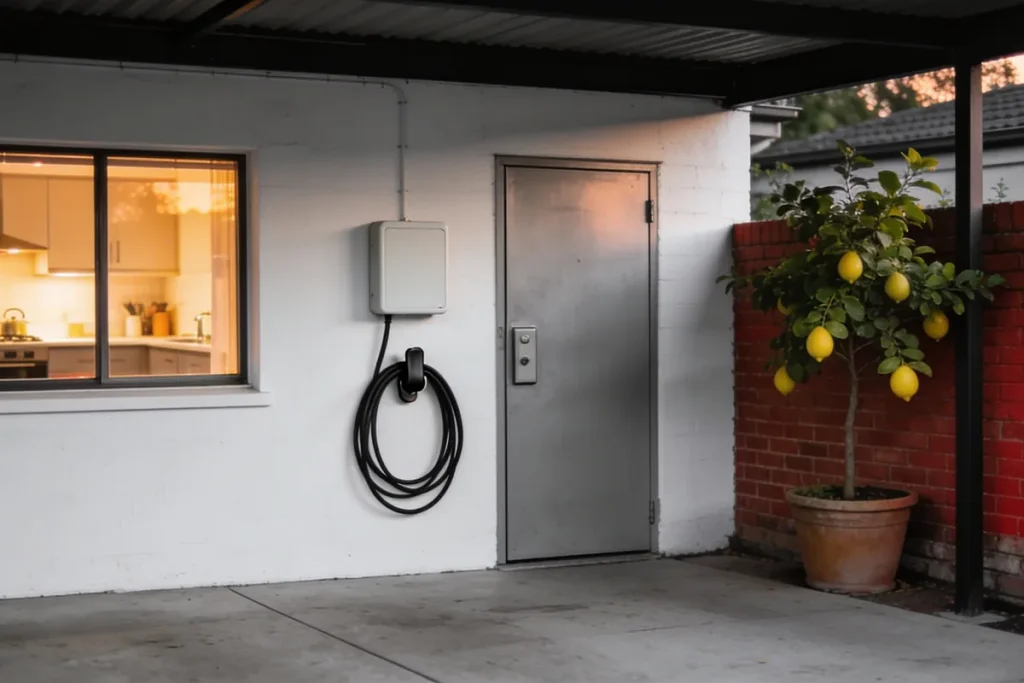
A new electric vehicle owner shopping for a wall charger tends to start with the charger: its rated output, its app, its cable length. The electrician who comes to quote the installation usually starts somewhere else entirely, with the switchboard, and then with a question about the car. That difference in order explains most of the confusion in home EV charger installation. The charger is the last decision in a sequence of four, and the first three (what the car can accept, what supply the house has, and whether the switchboard can carry another circuit) set the limits on it. The decision helper below walks through those four questions in order and returns a plain-text summary to take to an electrician. The sections that follow explain each step and the paperwork Victoria requires at the end.
Which home EV charger setup fits?
Four quick questions. Take the answer to your electrician.
Answer the questions and your summary will appear here.
What your car can accept
Every electric vehicle has an onboard charger, a component inside the car that converts alternating current from the wall into direct current for the battery. That component, not the wall unit, sets the ceiling on how fast the car charges at home. A wall charger rated well above the car’s onboard charger supplies power at the rate the car will accept and no faster, so the additional capacity delivers no benefit to that car.
The same logic applies to phases. Some cars accept AC charging on a single phase only. Connected to a three-phase charger, a single-phase-only car charges at single-phase speed. The reverse also holds: a car capable of three-phase AC charging, connected to a single-phase charger, is limited to the single-phase rate.
This is the one step a buyer can complete without anyone’s help, and it is also the one this guide cannot complete on the reader’s behalf. The car’s maximum AC charging rate is in its owner’s manual or specification sheet, usually expressed in kilowatts and sometimes alongside the number of phases. It is worth finding before any quote is requested, because it determines whether the more expensive three-phase charger has any purpose at all. Owners comparing installation quotes often reach this point only after pricing a faster charger than their car can use.
Your supply: single or three phase
The second constraint is the house. Homes are supplied either on a single phase or on three phases, and the charger has to suit whichever the property has.
Some householders can tell which they have from the switchboard or from details on the electricity bill, but the reliable answer comes from an electrician inspecting the meter and switchboard. Where a home is single phase and the car accepts three-phase charging, the question becomes whether adding three-phase supply is worthwhile. That decision, and its cost, sits with the electricity distributor and the electrician, and depends on the property. This guide does not estimate it.
The combinations reduce to a simple table:
| Car accepts | Home supply | Practical result |
|---|---|---|
| Single phase only | Single phase | A single-phase charger matches both |
| Single phase only | Three phase | A single-phase charger is sufficient; a three-phase unit adds nothing for this car |
| Three phase | Single phase | Charging is limited to single-phase speed unless the supply changes |
| Three phase | Three phase | A three-phase charger can use the car’s full AC rate |
Only the last row makes a three-phase charger necessary for its full output. In each of the other three, a single-phase installation is either the only option or an adequate one.
A worked example makes the table concrete. A household on a single-phase supply, with a car whose manual lists a maximum AC rate of 7 kW, gains nothing from a 22 kW wall unit: the supply cannot deliver three phases, and the car could not use them if it did. The same household, after buying a car rated for 11 kW three-phase charging, still charges at single-phase speed until the supply changes. In both cases the charger decision follows from two facts that can be established before any electrician visits.
The switchboard check
Once the car and the supply are known, the electrician turns to the switchboard, and this is frequently where the quote changes shape.
A home charger is normally installed on its own dedicated circuit, with residual current device (RCD) protection. The switchboard therefore needs physical space for a new circuit breaker and RCD protection appropriate to the installation. A modern board with spare positions may accept it with little alteration. A full board may need rearranging or extending.
Older boards are a different matter. Some older homes still have their original switchboards, with ceramic fuses rather than circuit breakers. An electrician asked to add a high, sustained load such as EV charging to a board of that age may well recommend upgrading the board first. In a house still running on its 1960s board, a charger quote can turn into a switchboard upgrade with a charger attached.
The practical consequence is that the switchboard upgrade can cost more than the charger itself. For that reason, it should be quoted as a separate line, so that the two costs can be compared and understood independently. A quote that bundles them into a single figure gives the buyer no way to tell which part of the price relates to the charger they chose.
Load management
A home’s supply has a finite capacity, shared between every appliance running at the same time. A charger drawing its full rating for several hours, while the oven, heating and hot water system are also running, can push total demand towards that limit.
Many chargers address this with load management: a sensor monitors the household’s total consumption, and the charger reduces its output when the house is busy and restores it when demand falls. On some properties, load management is the difference between installing on the existing supply and needing a supply upgrade.
Some chargers also offer solar-matching modes, which vary the charging rate according to how much a rooftop solar system is exporting at the time. These are features of particular products and installations rather than requirements, but they are worth raising with the electrician, since they can affect both the circuit design and whether a supply upgrade is needed at all.
Load management also changes what the electrician needs to know at the quoting stage. Expect questions about the largest appliances in the house, whether they run at the same time as overnight charging, and whether solar panels or a home battery are installed or planned. Accurate answers at the quote reduce the chance of a redesign once work has started.
Where it goes
The installation location is the most physical decision in the sequence and the one most often overlooked when a charger is bought online.
- Cable reach. The charger’s cable must reach the car’s charging port where the car is actually parked, not where it would ideally be parked. Measure from the proposed mounting point to the port, allowing for the car’s orientation. A household with two cars, or a car that sometimes parks nose-in and sometimes reverses in, should measure for the least convenient arrangement.
- Distance from the switchboard. A charger mounted beside the switchboard needs a short cable run. A charger at the far end of a driveway or carport needs a longer one, which affects the cost. Ask for the cable run to be itemised.
- Weather exposure. A charger in a garage is protected; one on an exposed wall or open carport needs a unit and installation suited to the conditions.
- Apartments. In an apartment or shared car park, owners corporation approval is generally required before any work begins, and the building may need a shared solution rather than an individual circuit.
The paperwork in Victoria
The final step is the one that protects the buyer if anything goes wrong later.
Energy Safe Victoria explains that electrical installation work must be carried out by a licensed electrician who is working for a Registered Electrical Contractor (REC). On completion, the electrician provides a Certificate of Electrical Safety (COES), a legal document that records the electrical work carried out. The COES requirement is set out in the Electricity Safety Act 1998 and the Electricity Safety (General) Regulations 2019. Energy Safe Victoria also advises consumers to ask to see the electrician’s licence.
The certificate is worth treating as part of the purchase rather than an administrative afterthought. It is the written record of who carried out the work and what was done, and it belongs with the property’s other documents. An owner who has not received one at the end of the job should ask for it.
Two further points are worth confirming with the electrician rather than assuming. The first is the category of the work: Energy Safe Victoria distinguishes between prescribed and non-prescribed electrical work, and the electrician will advise which applies to a particular installation. The second is whether the electricity distributor must be notified of the new load, which the electrician will also confirm.
The structure here closely resembles that for plumbing. A licensed tradesperson, a registered business behind them and a compliance certificate at the end are the same three checks this site’s guide to choosing a plumber in Melbourne recommends, applied to a different trade.
Ask about the board before the box
The sequence for a home EV charger installation in Melbourne runs in a fixed order, and the charger comes last.
| Step | Question | Who answers it |
|---|---|---|
| 1 | What is the car’s maximum AC charging rate, and on how many phases? | The owner’s manual |
| 2 | Is the home single phase or three phase? | The electrician, from the meter and switchboard |
| 3 | Can the switchboard take a dedicated circuit with RCD protection? | The electrician |
| 4 | Is load management needed to stay within the supply? | The electrician |
| 5 | Where will the car park, and how far is that from the board? | The owner, then the quote |
Only after those five answers does the choice of charger become a meaningful decision. A charger faster than the car or the supply can use adds cost without adding speed, and a switchboard upgrade, where needed, can be the largest item on the bill. Ask for the board work and the cable run to be quoted separately, ask to see the electrician’s licence, and expect a Certificate of Electrical Safety when the work is done.
Sources: Certificates of Electrical Safety for the community, Energy Safe Victoria (https://www.energysafe.vic.gov.au/certificates-electrical-safety/certificates-electrical-safety-consumers); Prescribed and non-prescribed work, Energy Safe Victoria (https://www.energysafe.vic.gov.au/certificates-electrical-safety/obligations-and-guidelines/prescribed-and-non-prescribed-work)