
A Christmas Party Venue in Melbourne: Read the Minimum Spend Before You Sign
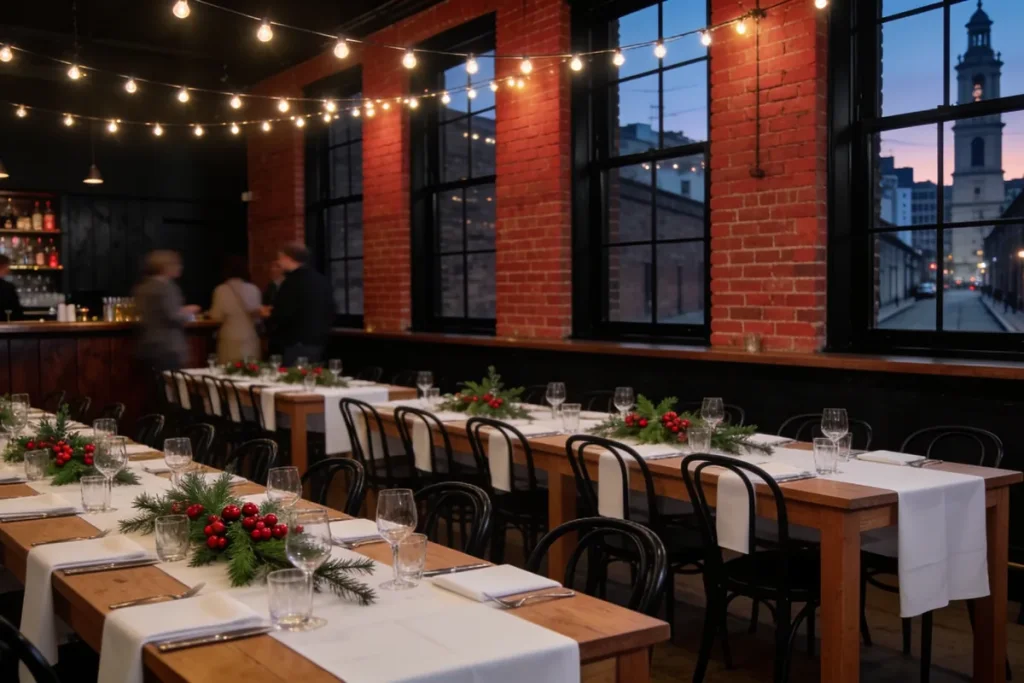
It is a Tuesday night in late October, and the person who somehow became the office social club secretary is sitting at the kitchen bench with two venue emails open side by side. The first is from a bar off a laneway in the city: room hire free, minimum spend applies. The second is from a pub with an upstairs function room in the inner south-east: room hire plus a per-head package, drinks and canapés included. Both rooms look lovely in the photos. Both venues answered within a day. And the secretary, who has eighty-odd colleagues waiting for a date, has no idea which one is cheaper.
The honest answer is that it depends. It depends on how many people turn up, how much they drink, what counts towards the spend and what happens if the group falls short. None of that is in the headline of either email. It is all in the terms, which get settled weeks before anyone orders a drink. This guide walks through them in the order you will meet them. It is general information, not legal advice.
How Melbourne venues price a function
There are three common ways a Melbourne venue prices a function, and they shift the risk in different directions.
Under a minimum spend, the room itself costs nothing, but the group must spend at least an agreed amount at the venue during the event. Food, drinks and the bar tab usually count towards it. Other charges often do not: security, AV equipment, cleaning and cakeage are commonly billed separately, on top. If the group spends less than the minimum, the venue will usually want the difference, and it is often charged as a room fee. Ask exactly how a shortfall is billed before you agree to anything.
Under room hire, you pay a fixed fee for the space and then pay for food and drink separately, either as you go or as a package.
Under a per-head package, you pay a set amount for each guest, usually covering a defined menu and a drinks package for a set number of hours.
| Model | You pay | Risk if numbers drop |
|---|---|---|
| Minimum spend | Nothing for the room; an agreed spend on food and drink | Any shortfall is usually charged, often as a room fee |
| Room hire | A fixed fee for the space, plus food and drink | The room fee stays the same however many come |
| Per-head package | A set price per guest for food and drinks | Depends on when final numbers lock in and what happens to no-shows |
Go back to the secretary’s two emails. If eighty people come and the bar is busy, the minimum spend may be reached easily, and the free room is a good deal. If forty come on a warm Friday when half the office has already left for the coast, the same minimum spend can leave a gap to cover. The per-head package is easier to budget, but it charges for every confirmed guest, whether or not they stay past the first drink. Neither is the cheap option until you know your numbers.
So the secretary does what experienced organisers do and works out a realistic headcount rather than a hopeful one. Last year’s attendance, the number of people likely to be on leave, how many have young children and will leave early: all of it goes into a rough estimate. The RSVP list will say one thing. The number who walk through the door on the night is often a little smaller, and the pricing model you choose should survive that gap.
The deposit and the cancellation clause
The secretary replies to both venues asking for their terms, and two documents arrive. This is the part most organisers skim, and it is the part that matters most.
Read it for four things. When is the deposit due, and is it refundable? What is the cut-off date for final numbers? What happens if attendance falls after that date? And what happens if you need to cancel altogether, or the venue does?
The secretary finds the answer to the third question on the second page of the laneway bar’s terms, in a sentence that is easy to miss: the minimum spend is fixed once final numbers are confirmed, whatever the attendance on the night. There is a logic to it, since by then the venue has rostered staff and ordered stock. But it means the date for final numbers is the real decision point, and it is worth putting in the calendar the moment you sign.
Consumer law has something to say here. Since 9 November 2023, businesses can face penalties for including unfair terms in standard form contracts with consumers and small businesses, according to the ACCC. Many function agreements are standard form contracts: the venue writes them, and the customer signs or walks away.
That does not mean any particular clause in your venue’s terms is unfair, and this guide does not suggest it. What it means in practice is simpler. Read the terms before you sign. If a clause worries you, such as a deposit that is lost entirely however far ahead you cancel, or a final-numbers date that seems very early, ask whether it can be changed. Asking costs nothing, and the worst answer is no. If the venue agrees, get the change in writing.
Surcharges and the late-December dates
Melbourne’s function season runs straight into the public holidays, and the calendar is worth checking before you choose a date.
In Victoria for 2026, Christmas Day falls on Friday 25 December and is a restricted trading day. Boxing Day falls on Saturday 26 December, and there is an additional public holiday on Monday 28 December, according to Business Victoria. Some venues close or change their hours across that stretch, and some add surcharges on public holidays.
Where a venue applies a surcharge on particular days, business.gov.au sets out how it should appear on a menu: a statement that a surcharge of a stated percentage applies on the stated day or days. So read the menu or the function pack for that line, and then ask the obvious follow-up. Does the surcharge apply to the minimum spend or the package price as well as to the menu? Does the minimum spend itself change on those dates?
Plenty of office parties fall well before Christmas. But family gatherings, sporting club breakups and the “we could not find a date in December” parties sometimes land on the 26th or the 28th, and a holiday surcharge on a minimum spend can change the arithmetic quite a bit.
What the function quote should list
By now the secretary has a shortlist of one. The venue sends a quote, and the job is to check it says everything it needs to. A function quote should list, in writing:
- the date and times: bump-in, start, last drinks and bump-out
- the room or area, and whether it is exclusive to your group
- the capacity of that space
- the menu and the drinks
- staffing for the event
- AV equipment
- security, if required
- accessibility for guests with mobility needs
- how dietary requirements will be handled
- the minimum spend or the package price
- any surcharges, and the days they apply
- the deposit and balance dates
- the cancellation terms and the final-numbers date
If something you discussed on the phone is not on the quote, ask for it to be added. A friendly conversation with the functions coordinator in October is not much help in December if that person has moved on and the written quote says something different.
If you are still deciding between two venues, put the quotes next to each other and go down the list line by line. Gaps show up quickly. One venue may include AV and security in its minimum spend while the other bills them on top, and that alone can reverse which one looks cheaper.
Questions before you sign
A few questions sort the good venues from the merely pretty ones.
Is the space private, or shared with the public? A “semi-private area” can mean a roped-off corner of a busy bar, which is fine for some groups and not for others.
If the booking is a rooftop or a courtyard, what is the backup if it rains? Melbourne in December can produce a heatwave and a downpour in the same afternoon, so ask where you go and whether it costs more.
Who is your contact on the night? The person who took the booking may not be working.
What happens if the party runs past the booked finish time? Some venues will extend for a fee, some cannot because another booking follows, and it is much easier to know which before the speeches start running long.
Is the bar tab capped, and can you get live updates as it runs down? A tab that runs out at 8.30 with no warning is a mood killer, and one that runs well past the agreed amount is a budget problem.
How will people get home? Check the public transport options near the venue, and whether late trains or trams suit your finishing time. That matters even more if the party runs into a public holiday timetable.
Responsible service of alcohol is the venue’s job. Ask how its staff handle it on a busy night, and listen for a plan rather than a shrug.
And if the booking turns out to be a wedding reception rather than a work party, the ceremony is a separate conversation. This site’s guide to choosing a marriage celebrant in Melbourne covers that side.
Read the spend, then send the invite
The secretary booked the laneway bar in the end. The free room helped, but the terms decided it: a minimum spend she was confident the group would reach, a final-numbers date two weeks out, a deposit that was partly refundable, and a written quote that listed the AV, the security and the time the bar closed. The invitation went out the next morning.
That is the order to work in. Understand whether you are paying a minimum spend, room hire or a per-head package, and what happens if numbers drop. Read the deposit and cancellation terms before signing, and ask for changes if something worries you. Check the late-December dates for surcharges. Get everything in a written quote. Then send the invite.
Sources: Business Victoria, Public holidays in Victoria for 2026 (https://business.vic.gov.au/business-information/public-holidays/victorian-public-holidays-2026); ACCC, Businesses urged to remove unfair contract terms ahead of law changes (https://www.accc.gov.au/media-release/businesses-urged-to-remove-unfair-contract-terms-ahead-of-law-changes); business.gov.au, Displaying prices (https://business.gov.au/products-and-services/fair-trading/displaying-prices)