
How to Choose a Marriage Celebrant in Melbourne: The Register, the Notice and the Ceremony You Want
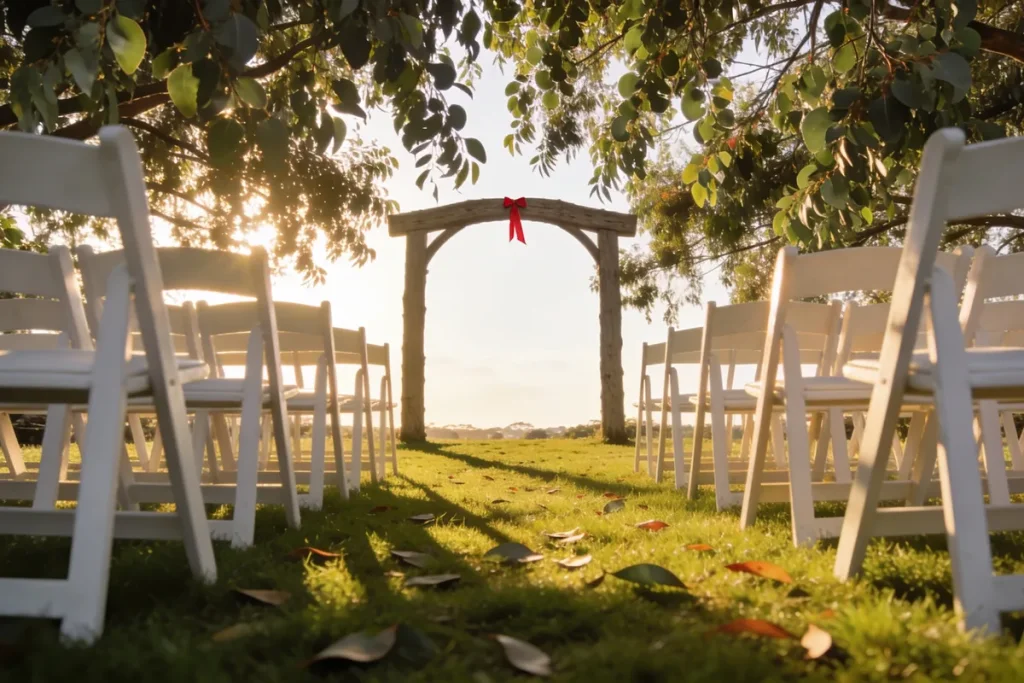
The bit of the wedding nobody films
It is the ten minutes before the aisle. A side room at the venue, or the front seat of a car in the car park, or a gate at the edge of a botanic garden with the ceremony setup just visible through the trees. There is a folder open on somebody’s knee, a pen that will not work the first time, and two people signing their names in three places while a third person checks that every line has landed where it should.
The photographs of the day will show the aisle, the kiss, the crowd with their hands in the air. They will not show this. And yet this is the part that makes the marriage. Of everyone you book for a wedding, from the florist to the band, exactly one person has a legal function, and without that person in that room, on that day, the marriage does not exist at all.
None of that is a reason to feel nervous about your celebrant. It is a reason to know, early, which parts of the day are about the photographs and which parts are about the law.
First, the only question that is genuinely legal
Is this person authorised?
A marriage in Australia has to be solemnised by an authorised marriage celebrant, and there is a public register of authorised marriage celebrants that anyone can search. So the check exists, it is free, and it takes about a minute. Most people never think to do it, and that is exactly why it is worth doing. You would not book a surgeon without confirming they were registered, and yet the person who performs a legal act at the centre of your wedding day often gets booked on the strength of a warm email.
Do it before a date is set and before a deposit is paid, rather than after. Ask the celebrant for their name as it appears on the register, then look it up and read what comes back. It is a completely normal thing to do, and a celebrant who is on the register will treat it as normal too.
What being on the register means
Registration is not a quality rating, and it is not a style endorsement. It is a legal authorisation, and it is the line that separates a celebrant from a very good public speaker. That distinction matters, because the two things get blurred constantly in how celebrants are sold. Being on the register is the floor of the job. Everything you actually remember about a ceremony, the warmth, the timing, the way a room settles when someone starts to speak, sits above that floor and is a completely separate question.
Holding those two ideas apart is the most useful thing a couple can do early. The register answers whether this person is allowed to marry you. It does not answer whether you want them to, and that second question is what the rest of this article is about.
The month that decides your date
The Notice of Intended Marriage
Before the wedding, the couple must give the celebrant a Notice of Intended Marriage. It has to be given at least one month before the ceremony, and no more than eighteen months ahead. In plain terms, it is the form that lets the celebrant check you are both free to marry and that the legal requirements are met. It is also the reason a short-notice wedding sometimes cannot happen on the date a couple has in mind. The one-month minimum is not a formality a celebrant can wave through, and it is far better to know that long before the seating plan is drawn.
Who has to see what
The celebrant must sight evidence of each person’s date and place of birth, evidence of identity, and, where either of you has been married before, evidence that the previous marriage has ended. This is the part that stalls couples, and knowing it in advance is the whole cure. The notice also has to be signed in the presence of an authorised witness, and it can be signed in person or witnessed remotely in the circumstances the rules allow. That last point matters enormously when one of the two is overseas in the months before the wedding.
Two witnesses, three certificates
The ceremony needs two witnesses over the age of eighteen, along with the celebrant. Three marriage certificates are signed on the day, by the couple, the celebrant and the witnesses, and one copy is the couple’s to keep. The celebrant then lodges the documentation with the Victorian registry within a short set period after the ceremony. It is worth saying plainly, because readers get it wrong constantly: the official marriage certificate you later apply for is a separate document from the one you sign on the day. The certificate in your hand at the ceremony is not the one a passport application will want, and the one you apply for afterwards takes time to arrive.
One more line, because it catches couples with family overseas: a marriage cannot be solemnised by video link or by proxy. The celebrant has to be physically present. The remote option applies to signing the notice, not to the ceremony itself, and those two things are easy to muddle in the excitement of planning.
A celebrant, or the Victorian Marriage Registry?
The registry route
The Victorian Marriage Registry, run by the state’s births, deaths and marriages office, offers a genuine alternative: a legal ceremony, at a set location, with the essentials handled properly. It is the right answer for plenty of couples, and people search for it in real numbers, which tells you it is not a fallback but a real choice. What it gives you is the legal step, done well, with none of the planning. What it does not give you is a ceremony shaped around the two of you, in the place you would have chosen, with the people you would have gathered around you.
The celebrant route
The other side, equally honest. A celebrant comes to you. They work around your venue and your people, and they carry responsibility for the legal process as well as for the ceremony itself. This is the route that gives you a wedding day rather than an appointment. There is a practical difference in timing too: a registry appointment is a slot you book, while a celebrant is a negotiation about a date, a place and a style. Neither route is better. They are answers to different questions, and the honest thing is to work out which question you are actually asking.
The conversation that tells you more than any profile
Every celebrant has a profile, and most of them are warm and well written. What a profile cannot do is show you how a person thinks on their feet, how they handle a room that has gone quiet, or how they talk about the legal part of the job. That is what the first proper conversation is for. It is not an interview, and you are not auditioning anyone. It is simply the moment where the style question and the substance question separate, and you can see which one the person in front of you is really answering.
First conversation: what to ask
- Their full name as it appears on the register of authorised marriage celebrants
- That name checked on the register, before any deposit
- What they need from us, and by when, for the Notice of Intended Marriage
- How the one-month minimum notice affects our date
- What happens if one of us is overseas when the notice is signed
- What they lodge afterwards, with whom, and what we receive
- Their plan if they are ill or unavailable on the day
- Whether they travel to our venue, and whether that is in the fee
- Whether a rehearsal is included
- How many ceremonies they have on our day
- The fee in writing, itemised, for our actual day and venue
- Deposit, and what happens to it if the date changes
The legal half
Are they authorised, and will they give you their name as it appears on the register? How often have they worked through the notice process, and what do they need from you, and when? What happens if one of you is overseas when the notice is signed? What do they lodge afterwards, with whom, and what do you receive? And what happens if they are ill or unavailable on the day; is there a documented plan, and who steps in? That last question is the one most couples never ask, and it is the one a serious celebrant answers without hesitating.
The ceremony half
How much of the ceremony do they write with you, and how do they handle the parts that are legally required so that those parts do not feel like a form being read aloud? Do they travel to your venue, and is that travel in the fee? Do they hold a rehearsal, and is that included? How many ceremonies do they have on your day? And can you read anything they have written? If you can read a ceremony, or even a passage they are proud of, you will learn more from it than from any testimonial.
The style question, asked properly
Your instinct will be to look for someone who is fun, or not too traditional. That is a hard thing to judge from a profile, and it is the wrong question to ask directly. A better one is what they do with a room that is nervous. The difference between a celebrant who is warm and a celebrant who is performing is the difference between someone holding the room and someone using it, and only one of those is what you want on the day. Ask them to describe a ceremony that went sideways, and listen to how they talk about it.
What the fee should cover
What is in and what is out
Ask for the fee in writing and itemised, because celebrant fees are not regulated and each celebrant sets their own. What is included: the ceremony itself, the paperwork and the lodgement, travel to the venue, a rehearsal, a second meeting. Then the specific trap. A fee quoted for a weekday elopement is not the same figure as a Saturday in a venue across town. Ask which of those the figure you have been given actually describes, and get the answer on paper.
Deposits, and what happens if plans change
What is the deposit, what is it held against, and what happens to it if the date moves or the wedding does not proceed? Get the cancellation terms in writing. This is a completely normal question with a completely normal answer, and a celebrant who has done this many times will have the terms ready to send.
The ceremony as it happens
Here is what the fee actually buys, and it is not the words. The words are written well in advance, and you could read them yourself. What you are paying for is the twenty minutes where a person holds a room: the pause that lets a nervous partner breathe, the careful redirect when a ring is dropped, the way they gather the attention of a hundred distracted guests without ever raising their voice. It is the part of the wedding that is genuinely about the two of you, and it is the part a registry appointment is not designed to give.

The question that matters most
Of everyone you book, this is the one person whose job makes the marriage real. So the order of things is simple. Check the register first, because that is the floor. Know the notice period early, because it sets your date. Decide honestly between the registry and a celebrant, without treating either as the lesser answer. Then choose the person whose work you actually want to be part of the day, and whose company you would not mind having in the room during the ten quiet minutes before it all begins.
One gentle action, and it costs nothing: look your celebrant up on the register, and if you have not booked one yet, write down the questions that matter most to you and ask them in the first conversation. You are not being difficult. You are doing the single thing that turns a booking into a marriage.
Sources: Attorney-General’s Department, getting married and the register of authorised marriage celebrants. Marriage Act 1961, notice to be given and declaration made. Births Deaths and Marriages Victoria, marriage certificates and the Victorian Marriage Registry.