
Bee Swarm on the Fence, Wasp Nest in the Lawn: One Is a Free Pickup, One Is Never DIY
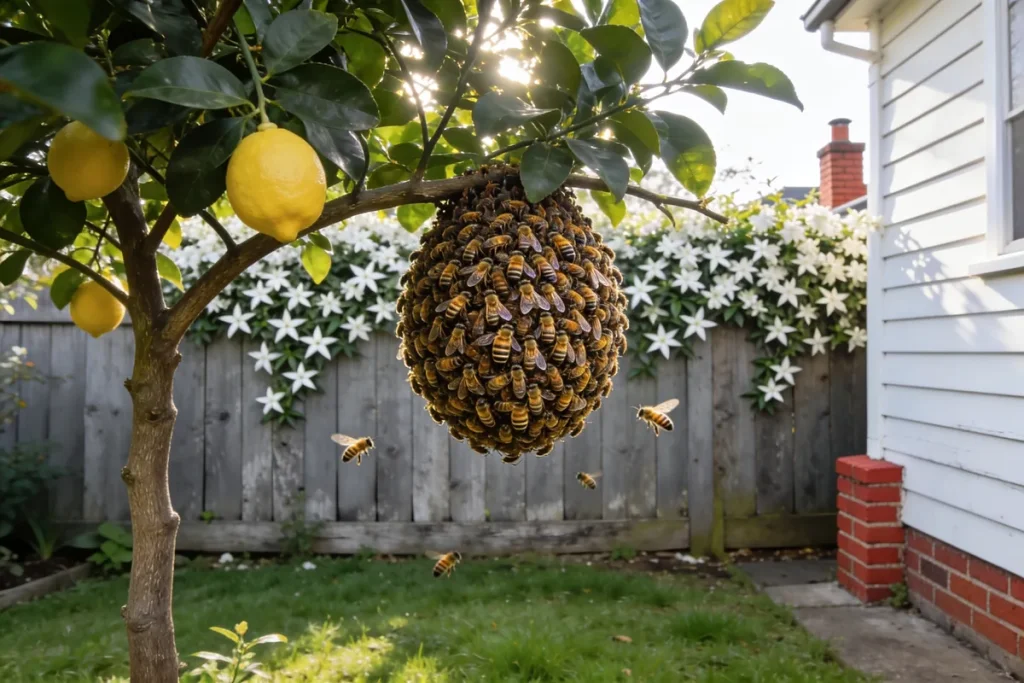
Picture a Coburg backyard on a warm morning in late October. A hypothetical one, but you will know the type: a weatherboard at the back of a long block, a lemon tree that has outgrown its corner, star jasmine flowering along the grey paling fence. Overnight, something has arrived on the lemon tree’s lowest branch. It is about the size of a football, brown and gold, and it hums. Watch it long enough and the whole mass seems to breathe.
Over the fence, the neighbours have visitors of their own. Yellow insects are flying in and out of a small hole at the foot of the retaining wall, one after another, low and businesslike, like cars leaving the car park after the footy.
From the back step the two scenes look much the same, and the answers could hardly be further apart. The cluster on the lemon tree is almost certainly a honeybee swarm, and the person to call is a registered beekeeper, who will often collect it for nothing. The hole by the wall is very likely a European wasp nest, and the person to call is a licensed pest controller, with no can of spray in the meantime. That is our position, and it is also the official one. The Better Health Channel says it is “strongly recommended” that you hire a licensed pest control operator for European wasps, and the Department of Health in Victoria tells pest controllers to refer bees to beekeepers, and beekeepers to refer wasps to pest controllers.
Name it first
Four creatures cause most of the backyard alarm in Melbourne between spring and autumn, and each has a tell.
A honeybee swarm hangs out in the open. It is a dense cluster on a branch, a fence post, a letterbox or the corner of an eave, and it is surprisingly calm. The bees on the outside barely move. A swarm is temporary: part of a colony has left home with a queen and is resting while scouts look for somewhere to settle. Whitehorse City Council notes that swarms often stay put for one or two days.
An established bee colony looks nothing like that. There is no cluster, only a steady traffic of bees going in and out of a gap in a wall, a soffit, a chimney or the roof. These bees have moved in. They are building comb and storing honey behind your plaster.
A European wasp is bright yellow with black triangle markings, yellow legs and two long black antennae, and about 12 to 16 millimetres long, according to Agriculture Victoria. The antennae are the giveaway. Its nest is hidden. About 80 per cent of nests are in or near the ground, in lawns, garden beds and retaining walls, and the rest are in buildings, in wall cavities and roof spaces. Usually all you see is an entrance hole and a stream of wasps.
A paper wasp is slimmer, with yellow or orange-brown antennae, and it flies with its legs dangling. Its nest is in plain view: a grey, papery umbrella of open cells hanging under the eaves, a pergola or a shrub, anywhere from golf ball to side plate in size, as Health Victoria describes it.
One more clue from Health Victoria, and it settles a lot of arguments: nests made of mud are not European wasp nests.
Plenty of photos shared online as “European wasp nests” are paper wasp nests, because the paper wasp is the one you can see. So if the nest is out in the open, it is probably not European wasps. If there is no nest at all, only a hole with wasps pouring in and out, slow down.
Who to call, at a glance
| What you see | What it probably is | Who to call | Who usually pays |
|---|---|---|---|
| A humming cluster hanging in the open | Honeybee swarm | A registered beekeeper, through SwarmPatrol or the Victorian Apiarists’ Association swarm locator | Often free when low and easy to reach; published guides put relocation at free to $150 |
| Bees going in and out of a gap in a wall, soffit or roof | Established bee colony | A beekeeper who does cavity removals, then a tradie to make good the wall | You. Published guides put it at $300 to $800, with repairs on top |
| Yellow wasps with black antennae, in and out of a hole in the ground or a wall | European wasp nest | A licensed pest controller, or your council if it is on council land | You, on private property. About $150 to $350 when easy to reach, more in a wall or roof |
| A grey umbrella nest in the open, slim wasps with dangling legs | Paper wasp nest | Nobody, if it is well out of reach. A licensed pest controller if it is near doors, windows or play areas | You. About $120 to $250 |
The swarm: report it fast, and leave it alone
The calendar is on the bees’ side right now. Whitehorse City Council puts swarm season at September to December, and search interest tells the same story: Australian searches for “bee swarm” peak in October, about 3,600 of them in October 2025, while searches for “European wasp” peak in January, at about 12,100 in January 2026. Agriculture Victoria says wasp nests grow through summer and reach their peak in early autumn. So if you are staring at a cluster in November, it is most likely a swarm, and any wasp nest you find this early is at its smallest. That is the cheapest and safest point to have one dealt with.
For a swarm, the job is mostly restraint. Do not spray it and do not hose it. Keep children and pets well away, and wear shoes in the garden.
Then report it. SwarmPatrol is a free network of beekeepers who collect swarms around Melbourne, and both Whitehorse and Boroondara councils point residents to it. The Victorian Apiarists’ Association also runs a swarm locator on its website, which lists beekeepers who collect swarms. We have not printed a phone number for the association, because the numbers published for it differ from one source to the next. The online locator is the reliable route.
Report it early. A low swarm on a lemon tree is an easy pickup, and Whitehorse notes that some beekeepers will do it for free. Once the same swarm moves into your wall cavity, it is a paid removal.
A common view among Melbourne gardeners online is to leave the swarm alone because it will move on by itself. Fair enough, and often it does, within a day or two. The catch is where it goes next, because a roof space or the gap behind the weatherboards suits a swarm nicely. Reporting costs you nothing, and the beekeeper may get there first. We would report it every time.
Hand it to a registered beekeeper, too, rather than a friend who fancies a hive, because varroa mite is now in Victoria. Some pages still say a varroa control order applies here; that is out of date. Agriculture Victoria removed the control area order on 11 September 2025, and the mite has stayed, including treatment-resistant mites found in north-east Victoria in May 2026. Agriculture Victoria asks beekeepers to keep their registration current, and a registered beekeeper is the right home for a swarm while the state manages the mite.
Bees in the wall: a paid job with a second bill
An established colony is a bigger job. The bees have to come out of the cavity, and so do the comb and the honey. Comb left behind in a wall can leak honey and stain the plaster or ceiling long after the bees have gone, so ask whoever quotes whether removing it is included.
Ask, too, who closes the wall. Reaching a colony can mean opening plaster, lifting roof tiles or taking off weatherboards, and making good afterwards is often a separate trade with its own invoice. If the job ends with a patched wall that needs finishing, our guide to reading a painter's quote in Melbourne covers what that second quote should spell out.
The European wasp nest: book a licensed pest controller
Health Victoria notes that European wasps can sting repeatedly, and that a disturbed wasp releases an alarm pheromone that calls others from the nest. Nests in Australia can hold more than 100,000 wasps. The entrance hole in the lawn is small; what sits behind it may not be.
It is also yours to sort out. Agriculture Victoria says the European wasp is naturalised and no longer notifiable in Victoria, so on private land nobody from government will come and deal with it.
Health Victoria says the best control is to locate the nest and destroy it with a registered insecticide, and that is the work licensed pest controllers do. Before you book, check the operator’s name on Health Victoria’s pest control licence holder register. It takes a minute, and it is the simplest piece of tradie vetting you will do this year.
Until they arrive, leave the nest alone. Do not block the hole and do not dig it out. Keep people and pets away from the flight path, and note where the wasps are coming and going so you can show the technician.
Plenty of people online would do it themselves: a spray from the hardware shop, after dark when the wasps are home and quiet. The appeal is easy to understand, because it is cheap and it is tonight rather than next week. We would still book the professional. A nest you cannot see may be far larger than its entrance suggests, or may run into a wall or under a path, and if the job goes wrong it goes wrong with many stings at once. And a nest taken for European wasps can turn out to be something else on a closer look. The official advice is clear, and a spring nest is the cheapest one you will ever pay to have removed.
Paper wasps: leave them if they are out of reach
Here the crowd and the health department part ways, slightly. A popular view is that paper wasps are harmless and should be left alone, and there is something to it: native paper wasps are part of a healthy garden. Health Victoria takes a firmer line, saying paper wasps should not be allowed to develop in or near the home, because they may attack if they feel their nest is threatened. Agriculture Victoria notes that the Australian paper wasp defends its nest aggressively.
Our ruling sits between the two. A small nest high on the back fence or deep in a shrub nobody touches can stay. A nest under the eaves by the back door, beside the clothesline or over the trampoline should go, and it is the cheapest job on this list.
What it costs (2026 published guides, not quotes)
These are published guide ranges, not quotes. Your price will turn on access, height, how established the nest or colony is and when you need someone.
| Job | Published guide range |
|---|---|
| Swarm relocation | Free to $150 |
| Paper wasp nest | $120 to $250 |
| European wasp nest, easy to reach | $150 to $350 |
| Wasp nest in a wall or roof | $250 to $500 |
| Bees in a wall or roof | $300 to $800 |
The ranges above are from The Quote Yard’s Victorian guide, published in June 2026 as estimates based on typical Victorian market rates. Airtasker’s guide, updated in August 2026, puts the Melbourne average for wasp nest removal at about $140 and notes that prices run higher in autumn, which is when nests are at their largest. After-hours work generally costs more, and repairs to a wall or ceiling after a bee removal come on top.
Council land, nature strips and power poles
Off your property, the call changes, and councils differ, so check your own council’s page. This is what four Melbourne councils say.
| Council | Council land or nature strip | Private property |
|---|---|---|
| Boroondara | Council removes wasp nests on council land, including nature strips (online form) | The owner’s responsibility; use a licensed pest controller. Swarms: SwarmPatrol |
| Knox | Parks Services deals with a nest posing a public risk | Council does not investigate infestations on private property |
| Whitehorse | Contact council about swarms on council property | Swarms: SwarmPatrol |
| Yarra | Not specified | The new Community Local Law, in force from 1 September 2026, requires property owners to promptly deal with bee swarms or wasp nests |
| Power poles | Whitehorse names United Energy; Knox names AusNet | Not applicable |
The power pole row is the one people miss. A swarm or nest on a pole is a job for the electricity distributor, so neither a beekeeper nor a pest controller should be your first call.
A nest on the neighbour’s side is a conversation before it is a callout. Boroondara’s advice is to talk to your neighbour first, and if that stalls, it names the Dispute Settlement Centre of Victoria. It is much the same approach as sorting out a shared fence with a neighbour: calm, early and in writing if it needs to be.
If someone is stung
Follow the official advice here, and only that. For a bee sting, healthdirect says to scrape the sting out with the edge of a fingernail or a card, and not to squeeze it. If you suspect anaphylaxis, use an adrenaline autoinjector, then call 000. Call 000 for any severe reaction.
The Better Health Channel says to get urgent medical care if the sting is in the mouth or throat, if a child has been stung more than five times, or if an adult has been stung more than 10 times. It also advises drinking through a straw, rather than straight from a can or bottle, when you are outdoors.
Name it before you call anyone
Back in the Coburg yard, the lemon tree and the retaining wall need two different phone calls, and neither of them is to the hardware shop. The cluster on the branch goes to a registered beekeeper through SwarmPatrol or the association’s swarm locator, and the sooner it is reported, the more likely it is a free pickup. The hole by the wall goes to a licensed pest controller whose name you have checked on the Health Victoria register, and spring is the cheapest time to have it done.
Left alone, the swarm will probably move on, though possibly into somebody’s roof. The wasp nest stays and keeps growing until autumn. So before you ring anyone, stand on the back step a minute longer and look: black antennae or yellow, a hole or an umbrella, a cluster or a stream.
Sources: European wasp, Better Health Channel (https://www.betterhealth.vic.gov.au/health/ConditionsAndTreatments/european-wasp); European wasps pest control, Department of Health Victoria (https://www.health.vic.gov.au/environmental-health/european-wasps-pest-control); European wasp, Agriculture Victoria (https://agriculture.vic.gov.au/biosecurity/pest-insects-and-mites/priority-pest-insects-and-mites/european-wasp)