
Ordering a Custom Cake in Melbourne: Price It by the Serve
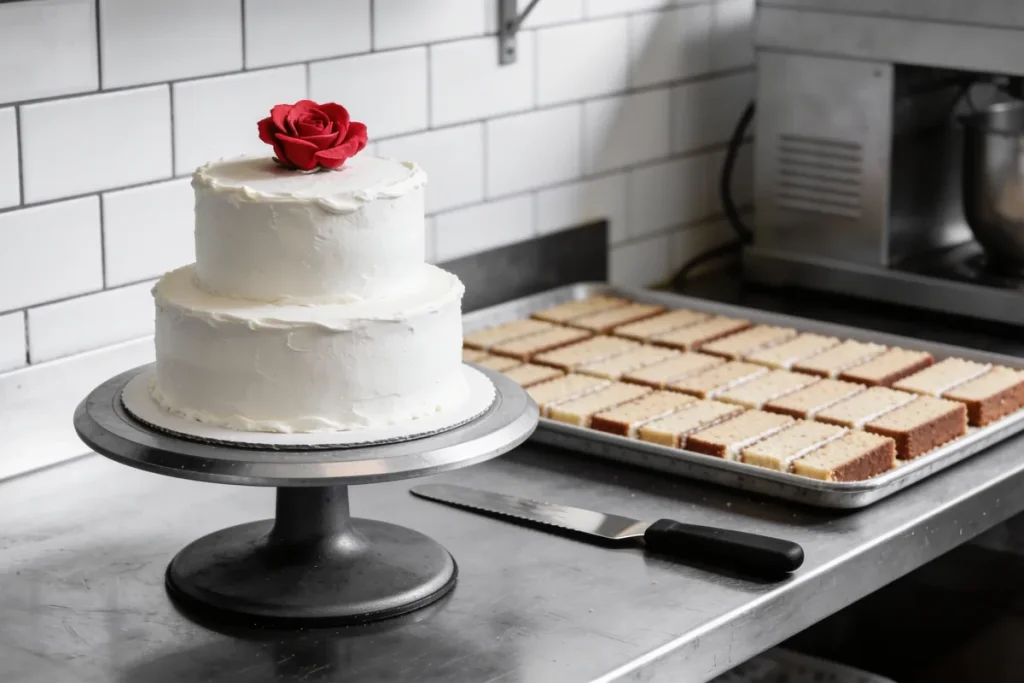
At half past six in the back kitchen of a small Fitzroy bakery, the baker takes a slab of chocolate cake out of the cool room, sets it on the steel bench and picks up a long knife and a ruler. She cuts it lengthways, then across, then across again, until the slab is a grid of neat fingers about the width of two fingers held together. “That’s a coffee serve,” she says, lifting one out. “What people have with a cup of tea after the speeches.” She cuts a second piece from the other end, three times the size. “That’s dessert.” The same cake, she explains, can feed forty people or a hundred, depending on which of those two pieces the customer has in mind. Half the quotes that confuse people make sense the moment someone shows them this. The calculator below does the arithmetic once you have a baker’s serve chart in front of you.
Cake serves and price per serve
Work out how many serves you need, check your tiers cover them, and compare quotes by the serve.
Serve sizes differ between bakers. Use each baker's own chart for the tier numbers.
Enter the number of guests and choose a serve type to see your result.
Serves are the unit
The parent who rang her last week had three quotes for the same birthday, and they were nowhere near each other. One baker had quoted for a cake to feed thirty, another for fifty, and the third for “thirty to fifty-five coffee pieces”. The parent had no idea what a coffee piece was, and had assumed the cheapest quote was simply the best deal.
It might have been. It might also have been a cake half the size. The only way to know is to stop comparing cakes and start comparing serves.
A coffee serve, sometimes called a finger serve, is the slim slice cut for a crowd that has already eaten, at a wedding or a big party where the cake comes out after the meal. A dessert serve is a proper slice on a plate, the cake as the pudding. The difference in size means the same tier can be quoted as two very different numbers of people.
So ask every baker for their serve chart. Many custom cake makers have one, showing how many coffee and dessert serves each tier size gives. The charts are not identical from one baker to the next, which is exactly why you need each baker’s own. Then work out the price per serve for each quote: the total divided by the number of serves of the type you actually need. Two quotes that looked wildly apart can turn out to be close, and two that looked the same can turn out not to be.
Before any of that, count properly. The baker’s habit is to add a little to the guest list: a few slices for the staff, a few for the guests who arrive late, and, at weddings, the top tier some couples keep for later, which then feeds nobody on the night. The calculator’s extra-serves box is there for that margin. It is easier to have a few fingers left on the tray than to watch the last table go without.
What moves the price
Once the serves line up, whatever difference is left in the price usually comes from the work rather than the size.
Flavours and fillings are the first part. A plain sponge with buttercream is a different job from layers with fruit curd, ganache and a soak. Tiers bring structure: every tier above the first needs internal supports and boards so the cake does not sink into itself, and the baker has to build that in. Decoration is often the biggest variable of all, because it is measured in hours. Smooth buttercream takes time. Hand-piped detail takes more. Sugar flowers, made one petal at a time and left to dry, can take longer than the cake.
Delivery and set-up are the last part. A cake that is picked up from the bakery is a different price from one driven across town, carried up a flight of stairs and assembled on a stand in a venue.
There is one more option worth asking about when the numbers do not fit. If the display cake you love is a tier short of feeding everyone, some bakers will make a plain cutting cake, a simple slab kept out of sight in the kitchen and cut into serves alongside the display cake. The guests get the same flavour. The baker skips the decoration on the part nobody sees.
Knowing where the hours go is useful mainly because it tells you what to ask. Ask each baker what their price includes, and you will usually see where the gap between two quotes comes from.
Deposits and lead times
The baker keeps a paper diary on the bench, and in late spring it fills up fast. Weddings book months ahead, December is busy with end-of-year parties, and a birthday cake ordered the week before can be a squeeze in either season. Lead times vary from baker to baker and from job to job, so book as early as you can, especially for a wedding or anything in December.
Whatever the timing, get the order in writing. A clear written order should state:
- the date and time of pickup or delivery
- the number and type of serves
- the design, flavours and fillings, with any reference photos attached
- the deposit amount and when it was paid
- the date the balance is due
- the cancellation terms, including what happens to the deposit
It sounds formal for a cake. It is the document both of you will reach for if anything goes wrong.
Home bakers and registration
Some of the loveliest cakes in Melbourne come out of home kitchens, and that is fine, provided the kitchen is set up properly to sell food.
The Department of Health Victoria explains that local councils register and regulate most food businesses in the state. A home kitchen that sells cakes is a food business, and it must be registered with its council. So ask any baker, home or shopfront, for their council food registration. A baker who is registered will not mind the question. It is a quick, polite check, and it tells you the kitchen is known to the council.
Allergens
The child turning seven has a tree nut allergy, and the parent mentions it almost as an afterthought at the end of the call. The baker stops writing and asks three more questions.
Food Standards Australia New Zealand sets the rule here. For food that does not have to carry a label, such as food from a café or a made-to-order business, allergen information must either be displayed with the food or provided when the customer asks, using the required allergen names. A custom cake usually sits in exactly that category.
In practice, that means asking. Ask the baker, in writing, which allergens are in the cake, the fillings and the decorations. Then ask about cross-contact: whether the allergen is used elsewhere in the same kitchen, on the same benches or with the same equipment. Get the answers in writing too. For a guest with a serious allergy, that conversation matters more than the flavour of the sponge.
Getting it there in one piece
The finished cake is the most fragile thing most people will ever put in a car. Bakers have stories about the cake that slid off a seat on a hot afternoon on Hoddle Street, and the tier that tipped when someone braked on a speed hump.
If the baker offers delivery, it is often worth taking, especially for a tiered cake. If you are collecting it yourself, plan for a flat surface, usually the floor of the boot or a flat car floor, rather than a seat, which slopes. Keep the car cool, drive as if you are carrying a full pot of soup, and go straight there.
At the venue, find out where the cake will sit, who will set it up and whether a cool spot is available. Wedding couples can ask their celebrant how the order of the day runs and when the cake will be cut, which this site’s guide to choosing a marriage celebrant in Melbourne touches on. For a work function, check whether the venue allows outside cakes and how it handles them, a question that sits alongside the other terms covered in the guide to booking a Christmas party venue in Melbourne.
Count the guests, then the cake
By half past seven, the slab on the Fitzroy bench has become a tray of perfect fingers, and the baker is back at her diary.
Every good cake order, she says, starts with the same question, and it is not about the design. How many people, and how big a slice? Count the guests, add a few for the late arrivals and the staff, and decide whether you want coffee serves or dessert serves. Ask each baker for their chart, and compare quotes on the price per serve. Get the order in writing, with the deposit and the balance date. Ask for the council registration and the allergens in writing. And give the cake a flat floor on the way there.
Sources: Starting a food business: what you need to know, Department of Health Victoria (https://www.health.vic.gov.au/food-safety/starting-a-food-business-what-you-need-to-know); Allergen labelling for food businesses, Food Standards Australia New Zealand (https://www.foodstandards.gov.au/business/labelling/allergen-labelling)