
The First Question for a Pressure Cleaner Is Where the Wash Water Goes
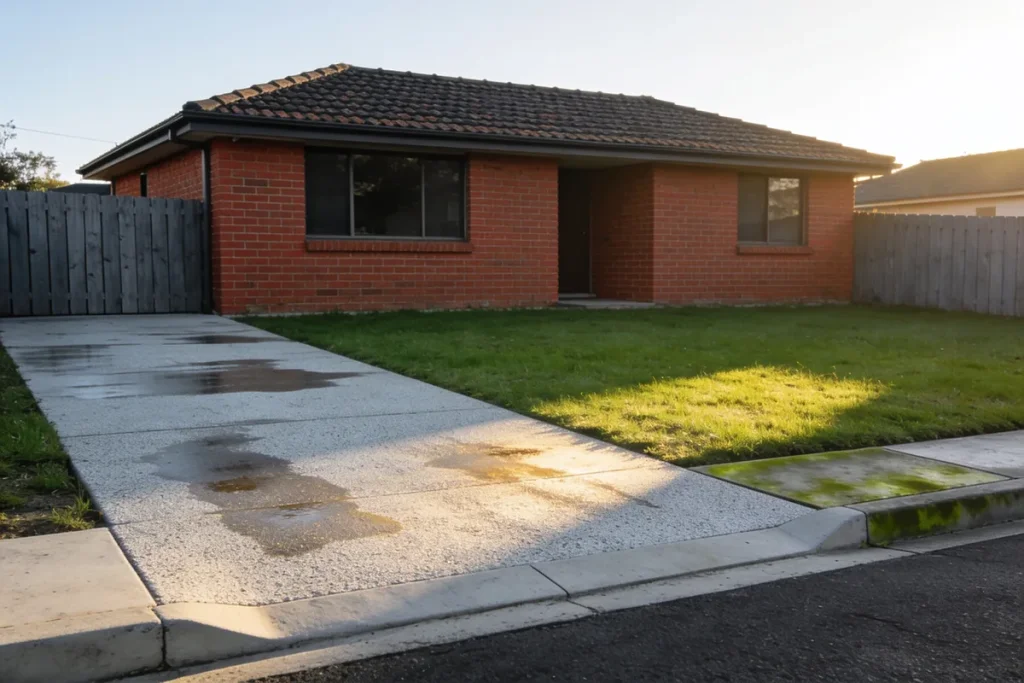
It is November, the front path has gone green again, and you have three quotes sitting in your inbox. They all say roughly the same thing: a price per square metre, a minimum charge, a start date. If you have been putting this job off, you are in good company, and it is a smaller job than it looks. A pressure clean is a normal, worthwhile thing to book.
What almost none of those quotes says is where the dirty water goes once it leaves the surface. That is the gap this post fills, and it is our position in one line: ask where the wash water goes before you ask the price. We are not saying it because you are about to break a rule. We are saying it because the answer travels with the method, the clean-up and the insurance, so it is the quickest way to tell a careful operator from a rushed one.
Along the way you will get what a good answer sounds like, a rate guide with a worked example, and the rest of the phone call.
Why the wash water comes first
Stormwater drains are not the sewer. Melbourne Water describes the path like this: the gutters at your house feed council drains, those feed its regional drains, and from there the water runs on to the nearest creek or river and eventually the bays. Some of it passes through wetlands on the way, so we will not say it arrives untouched. We will say that nobody designed that system for soapy water.
EPA Victoria’s position is that stormwater drains are meant to carry rain and nothing else. Its general environmental duty applies to activities that may affect stormwater, and it counts wastewater as part of that. Everyday activities can cause harm, not only big spills, and the duty is framed around what is reasonably practicable. For households, EPA’s advice is gentle and practical: sweep rather than hose, and wash the car on the grass or at a car wash that recycles its water.
Two EPA cases show what the regulator has acted on. In March 2025 it fined a builder whose high-pressure cleaners cleared a surface bonding agent from a new driveway, sending the contaminated water into drains that run to a river. In May 2026 it fined a car wash whose wastewater system had blocked.
The other side has a fair point. Both cases involve a business, and both involve something other than plain water: a bonding agent, car-wash waste. We found no EPA, council or Melbourne Water page that says what a household may do when it pressure cleans its own driveway, so we will not invent one. A common view online is that nobody gets fined for this, so relax. For plain water over a clean path, the harm really is small.
Where we part ways is on the word “plain”. Detergent, moss treatment, oil, flaking paint and bonding agent are what turn a harmless rinse into something you would rather not send to a creek. That is why the question works as a test of the operator. A professional who has thought about the water has usually thought about the rest of the job too. One who shrugs at the question tells you something as well.
A blocked pit or a drain that does not seem to go anywhere is a different job. It belongs with a licensed plumber, not a pressure cleaner, and our guide to choosing a plumber in Melbourne covers how to vet one.
Follow the slope
You can do some useful homework before anyone turns up, and it takes about five minutes. Stand at the top of your driveway and look down it. Which way does the concrete fall? Does it run to the lawn, to a garden bed, or to the kerb? Where is the nearest stormwater pit, and does it sit at the bottom of your slope?
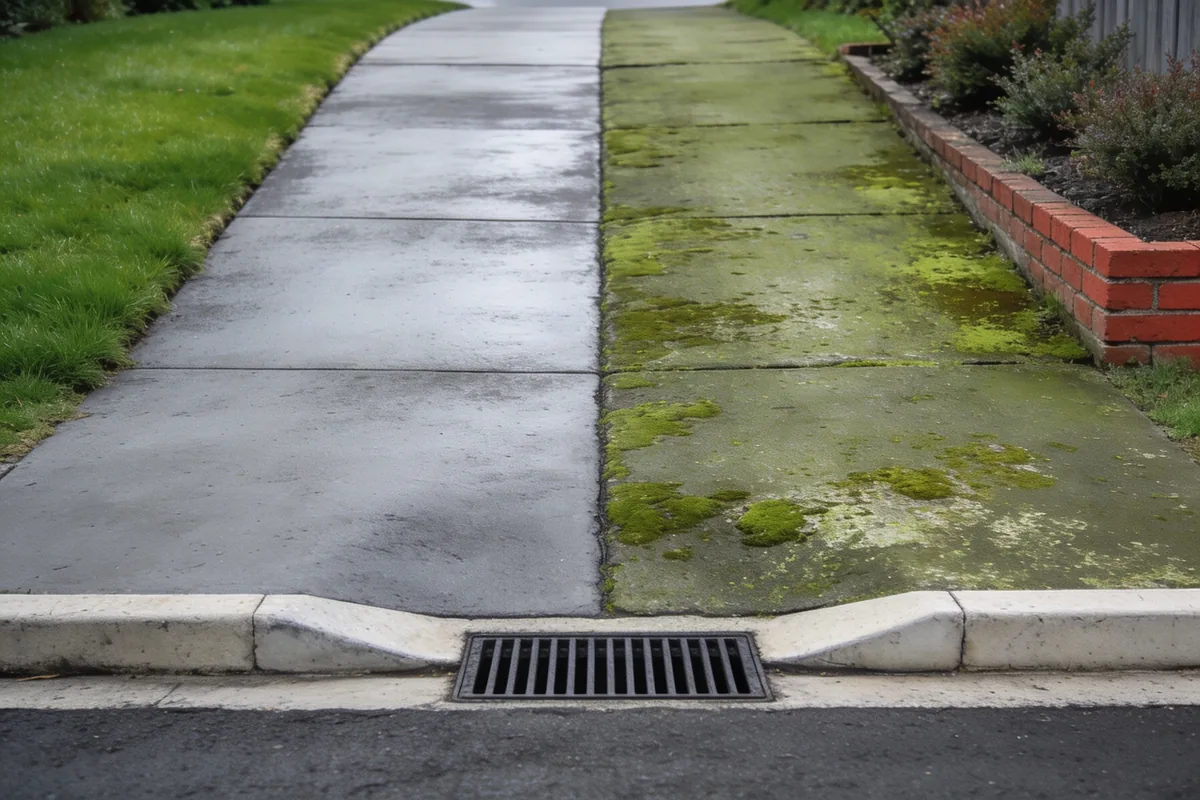
That small piece of knowledge lets you judge the answers you get. A good answer usually sounds like one of three things:
- The water stays on your lawn or garden and soaks in, because the job has been planned around the fall of the slope.
- The water is captured with a vacuum or a bund and taken away.
- The drain is dealt with first, by blocking or covering it before the cleaning starts.
A worrying answer is “it just runs down to the street”, particularly on a job with detergent, oil, moss treatment or flaking paint in the mix. Plain water from a rinse on a clean path is one thing. A slick of degreaser heading for the gutter is another.
Whose water, and how much
The next question is where the water comes from. Victoria has permanent water saving rules, and the Victorian Government page describing them was updated in January 2026. In short, mains water should not be used to clean hard surfaces such as concrete, paths and driveways. There are exemptions, and they matter:
- cleaning needed because of an accident, fire, or a health or safety hazard;
- staining that has developed, and then only once a season;
- construction or renovation work.
Even then, the rule says a high pressure water cleaning device should be used if one is available, and otherwise a hand-held hose or bucket. The rules define a high pressure cleaner as an electric or petrol device that delivers 9 litres a minute or less. They apply to drinking water from the network, not to tank, bore, grey or recycled water.
What does that mean for you? Our reading is a reassuring one. A commissioned clean of stained concrete sits inside the exemption, and using the proper device is exactly what the rule asks for. Hosing the leaves off the path as if it were a broom does not sit inside it. So “do you use my tap or your own tank?” is a fair thing to ask, and it is a tidy way to learn how the operator works. We are not suggesting any operator breaks the rule. It is simply a good way to learn how they work.
Method by surface
Once the water question is settled, the next thing separating a good quote from a vague one is method. Different surfaces need different handling, and the guides we read, which are industry guidance rather than regulation, agree on the broad shape for most of these surfaces. The tile-roof row is the exception: it rests on householder reports, not on a guide or a primary source.
| Surface | What to ask for | What goes wrong |
|---|---|---|
| Plain concrete | High pressure with a surface cleaner | An uneven finish if the wrong tool is used |
| Exposed aggregate | Care and a lighter pass | Stones loosen and lift |
| Pavers | Cleaning plus a plan for the joints | Joint sand washes out, and re-sanding is usually extra |
| Render, painted walls, weatherboards | Soft wash, meaning low pressure with a cleaning solution | High pressure can blow water behind cladding and strip paint |
| Timber deck | Low pressure, wide tip, along the grain | Gouged or furred timber if the pressure is too high |
| Tile roof | Top down, with written clean-up and insurance confirmed | Water getting into the ceiling cavity |
On roofs, one risk deserves a name. Householders report that concrete tile roofs without sarking, the sheet under the tiles, can let water into the ceiling cavity if it is pushed under them. That comes from those reports, not from any guide or primary source we opened. We are not saying it will happen, only that a sensible operator should have checked before getting up there. If you are cleaning ahead of a repaint, soft wash and surface prep are part of getting that job right, and our guide to getting a painter's quote in Melbourne explains what a decent prep line looks like.
Then there is old fibro, which means eaves, fences, sheds and roofs that might contain asbestos. This is the one row on the page where we say stop. WorkSafe Victoria’s regulation 216 under the Occupational Health and Safety Regulations 2017 says an employer or self-employed person must not use a high-pressure water jet, or a broom, brush or power tool, on asbestos-containing material unless the use is controlled. The qualifier is the important part, and it is aimed at the operator rather than at you. In practice, a hired professional should test or rule out fibro before starting, so ask about it if your house is old enough.
What the price should add up to
It helps to know the shape of a fair total. What follows is a worked example of our own, not a quote and not a promise. Take a hypothetical Melbourne house with a 55 square metre plain concrete driveway, a 15 square metre paver front path, a 25 square metre plain concrete rear patio and two oil patches. That is 95 square metres in all.
The rates come from one national cost guide, published in October 2026, which gives per-surface ranges including GST: $3 to $6 a square metre for concrete, $4 to $8 for pavers, and $50 to $150 for oil treatment. We used the midpoint of each range for the middle column.
| Item | Size | Guide rate (incl. GST) | Low | Mid | High |
|---|---|---|---|---|---|
| Driveway, plain concrete | 55 m2 | $3 to $6 per m2 | $165 | $247.50 | $330 |
| Front path, pavers | 15 m2 | $4 to $8 per m2 | $60 | $90 | $120 |
| Rear patio, plain concrete | 25 m2 | $3 to $6 per m2 | $75 | $112.50 | $150 |
| Oil treatment, two patches | 2 | $50 to $150 in total | $50 | $100 | $150 |
| Total | 95 m2 | $350 | $550 | $750 |
The mid column is the midpoint of each range, so two lines carry cents and the column adds to $550. The total clears the usual minimum charge, which the guides put at about $150 to $250, so the minimum would not apply here. As a cross-check, the same guide prices a driveway, front path and rear patio of 100 to 130 square metres at $450 to $850, and our 95 square metre example sits comfortably alongside that.
Two lines are left off the sums on purpose: wash-water capture and the clean-up of overspray. We could find no published household price for either. One guide says capture adds cost and that cheaper quotes sometimes skip it. We are not printing a figure we cannot support. Treat both as lines to ask about.
A ruling where the sources disagree. You will see “$1.50 to $5 a square metre” in plenty of places, including a marketplace guide last updated in May 2025 and a cleaning business’s guide. The per-surface table above, from this October, runs from $3 to $8. Our advice is to price by surface and to trust the newer, itemised figures over a single national average. A flat average hides the difference between a plain slab and a paver path with joints to re-sand.
Roof cleaning is the other place the numbers wander. The guides we read put it anywhere from $150 to $1,500 and over, for what sounds like the same job. That spread is not a sign anyone is overcharging. It is a sign the quotes describe different work. Never compare roof quotes unless the method, the access and the clean-up are written down on each. A cheap quote is not automatically a careless one, but a vague one cannot be compared.
Seven questions for the phone call
Ask these in this order and your three quotes will start to look comparable. Each comes with what a good answer sounds like.
- Where will the wash water go? It is the question this post is about. A good answer names a plan: onto the lawn, captured, or the drain dealt with first.
- Do you use my tap or your own tank? Victoria’s water rules apply to mains water only, so the answer tells you how they work. Either answer can be fine, as long as they have one.
- Which method and pressure on each surface, and have you checked the roof and any fibro? A good answer is specific by surface, in plain words, with no mention of fibro being skipped.
- What product goes on, and where does it end up? Detergents and moss treatments are the reason the water matters. A good operator can tell you what it is and how they handle it.
- Who cleans overspray off the house, windows, gutters and the neighbour’s side, and is it in the price? Overspray is a common worry, and a good answer is “we do, and it is included”. If a shared boundary is involved, our guide to the shared fence notice in Melbourne covers the neighbour’s side of things.
- Can I see your current public liability certificate and ABN? A good answer is a quick yes, with a document you can read.
- Can I have the scope in writing? It should list the areas with approximate square metres, the method per surface, stain treatment and its limits, the minimum charge, GST, and when you pay. Paying on completion is a fair arrangement.
Put the wash water on the quote
Ask for the wash water as a line on the quote, right next to the price per square metre. It costs you one question, and it makes the quotes comparable in a way a per-metre figure never will. Two operators charging the same rate can be doing very different amounts of work.
Plain water on a clean path is a small thing, and the cases we found involved businesses, not households. The question earns its place because it separates the people who plan from the people who rush. Spring is the busy season, so book early and give yourself time to ask.
Sources: Stormwater, EPA Victoria (https://www.epa.vic.gov.au/stormwater); ASK Developers fined for contaminated wash water runoff, EPA Victoria (https://www.epa.vic.gov.au/ask-developers-fined-contaminated-wash-water-runoff); Car wash grime leads to fine, EPA Victoria (https://www.epa.vic.gov.au/car-wash-grime-leads-fine); Drainage system, Melbourne Water (https://www.melbournewater.com.au/water-and-environment/flooding-and-drainage/drainage-system); Permanent water saving rules, Victorian Government (https://www.water.vic.gov.au/for-households/water-restrictions-and-rules/permanent-water-saving-rules); Use of power tools on asbestos, WorkSafe Victoria (https://www.worksafe.vic.gov.au/safety-alerts/use-power-tools-asbestos); How Much Does Pressure Cleaning Cost, Yakka Labour (https://yakkalabour.com.au/cost-guides/pressure-cleaning-cost/); Pressure washing cost, Airtasker (https://www.airtasker.com/au/costs/high-pressure-cleaning/pressure-washing-cost/); Your Guide to Pressure Cleaning Costs, That Cleaning Crew (https://www.thatcleaningcrew.com.au/pressure-cleaning-cost/)
